 Milford Sound Boat Tour
What Milford Sound Wildlife Will You Actually See?
Milford Sound wildlife is one of the main reasons people cruise this 15 km fiord, and it is also the part of the trip most wrapped in marketing promises. This guide ranks every animal by how often trips really see it, from fur seals and dolphins to the Fiordland crested penguins that spend long stretches of the year at sea. You will find where each species lives, when it is genuinely absent, the Department of Conservation distance rules that protect it, and how the Milford Sound boat tour options differ. Nothing here is guaranteed, and no honest operator claims otherwise.
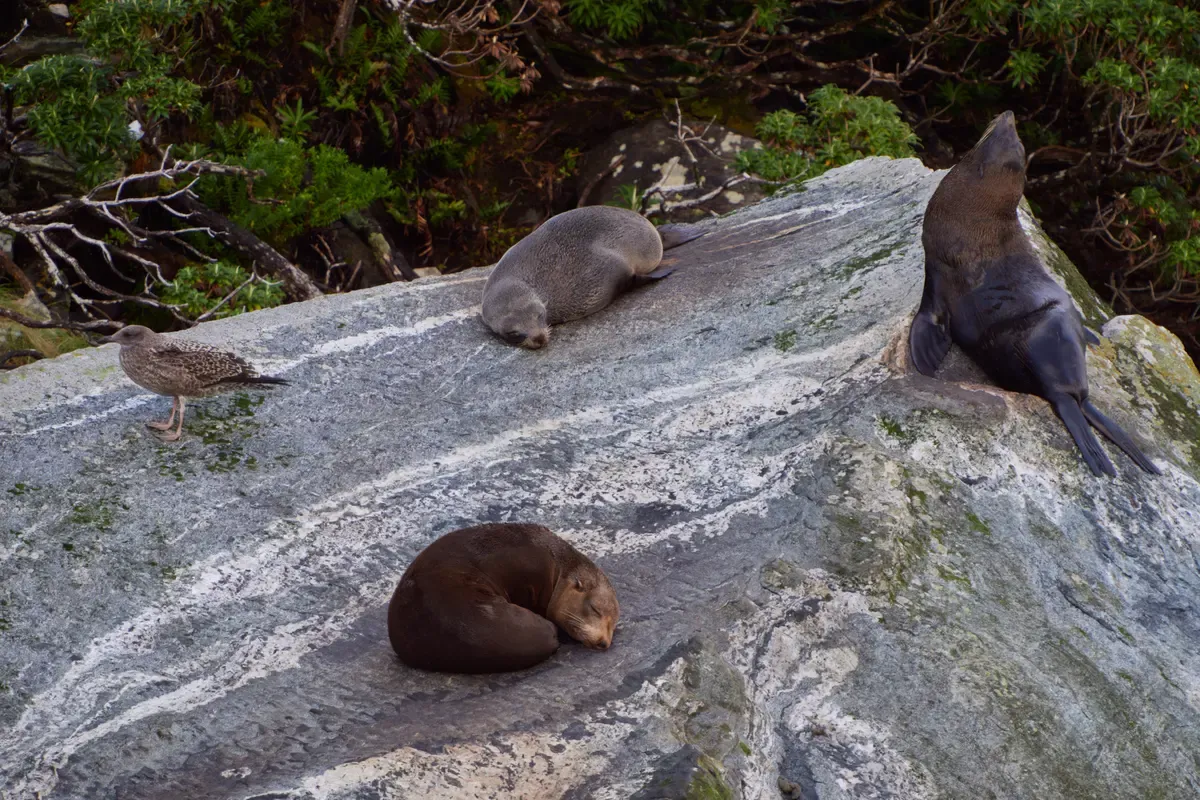
New Zealand fur seals resting on a granite rock beside a juvenile seagull. Photo: lumoplank, CC0, via Wikimedia Commons
Quick answer Sighting odds at a glance
New Zealand fur seals, the resident bottlenose dolphins and, in the breeding season, Fiordland crested penguins (tawaki) are possible sightings, and sandflies are likely along the foreshore. No sighting is guaranteed. RealNZ itself lists penguins, dolphins, albatross and fur seals as possible sightings and states plainly that sightings are not guaranteed, and every operator in the fiord works the same way.
Key takeaways
- Fur seals are the most common seals in New Zealand and haul out on rocks around the fiord, and the Mitre Peak Small Boat Cruise names Seal Rock on its route, but no sighting is guaranteed.
- A resident population of bottlenose dolphins lives here, the southernmost wild population of the species, but they swim where they choose. See how cruises on the fiord differ.
- Tawaki are best seen from July to November, with RealNZ calling April one of the first reliable months, so the calendar matters. Kea and whio live on the Milford Road, not the fiord.
- Penguins are not there year-round, and the underwater world of black coral needs a dive. The full sighting table below is the honest baseline, and the comparison of Milford Sound boat tours shows which trip suits each.
Milford Sound Wildlife At a Glance
This is the honest baseline for a Milford Sound wildlife trip, ordered from most to least likely. The likelihood wording is fixed and deliberately plain, because operators sell certainty that the fiord does not supply. Real Journeys' concession with DOC lists cumulative viewing time of about 30 minutes with seals and 15 minutes with dolphins on Milford Sound day cruises.
The Species Calendar
The table below carries the full detail for this page. Notice the two rows with genuine absence windows: tawaki leave the fiord for long stretches at sea, and seal pups only appear from spring. Under the table is a note on what actually decides whether a present animal becomes a seen one.
Weather, boat distance and light all shape what you personally spot. The dark tannin freshwater layer lets black coral grow at 10 m, and DOC describes those species as visible at diving depths, not from the deck. Visibility above water changes hour by hour with rain and wind, which the Milford Sound weather guide covers in full.
| Species/Sight | Where in Milford Sound | Best months | How likely |
|---|---|---|---|
| New Zealand fur seals (kekeno) | Rocks along the fiord | Pups from September | Possible, never guaranteed |
| Sandflies (namu) | Foreshore and landings, not on moving boats | Year-round | Possible, never guaranteed |
| Bottlenose dolphins (aihe) | Anywhere in the fiord | Year-round | Possible, never guaranteed |
| Fiordland crested penguin (tawaki) | Steep rainforest shoreline | July to November breeding, mid-January to early March moulting, gone at sea otherwise | Possible in season, never guaranteed |
| Black coral and red coral | Northern rock wall of the Piopiotahi Marine Reserve | Year-round underwater | Needs a dive, never guaranteed |
| Kea | Homer Tunnel area and Monkey Creek on the road | Year-round | Possible, never guaranteed |
| Whio (blue duck) | Monkey Creek | Year-round | Possible, never guaranteed |
| Humpback or southern right whales | Not stated | Not stated | Rare |
Read-out
Two lines matter most. First, no row is guaranteed, so a trip that markets seven species is selling hope, not odds. Second, the section below maps the named sites to the trips that reach them.
Where an animal has a legal minimum distance, it is noted in its own block and cross-referenced in the responsible viewing section. For month-by-month depth on the seasonal species, the penguin row is the one worth reading twice.
Seals and Sandflies
Fur seals and sandflies are the two animals the sources place most firmly in the fiord, and neither is guaranteed on a given sailing.
New Zealand Fur Seals (kekeno)
A bulky brown seal, males up to 160 kg and about 2 m, females 30-50 kg and about 1.5 m. Seal Rock is named on the route of the Mitre Peak Small Boat Cruise. Pups appear on rocky outcrops from September, per RealNZ.
DOC rules say stay at least 20 m from seals on shore and never come between a seal and the sea. Fur seals are the most common seals in New Zealand and their population is growing. Boats that run close to the shoreline, such as the Mitre Peak Small Boat Cruise at $100 per person for 2 hours, are purpose-built to work near the rocks.
Sandflies (namu)
Small biting flies from the Austrosimulium genus. They live on the foreshore and at landings such as Sandfly Point, not out on a moving boat deck. Southern Discoveries says they are manageable on cruises but appear along the foreshore, so bug spray is recommended.
They are technically Milford Sound wildlife too, just not the kind you photograph on purpose.
Dolphins
One species sits in this tier, and it is the one most people rank first. The honest framing is that dolphins live here permanently but are not on call, so your odds ride on the length of the cruise and the skipper's eyes.
Bottlenose Dolphins (aihe)
Large grey dolphins that reach just over 4 m and average 300 kg. Milford Sound holds a resident population, the southernmost wild population of bottlenose dolphins anywhere. The marine reserve is 16 km long, and sightings on any one trip are never guaranteed.
DOC rules say approach dolphins from behind and to the side, keep to 10 knots or less within 300 m, and never cut through a group. Longer cruises that run the full length to the Tasman Sea, like the Glass-Roof Catamaran Cruise at $93 per person for 105 minutes, cover more dolphin water than short turns around the middle fiord.
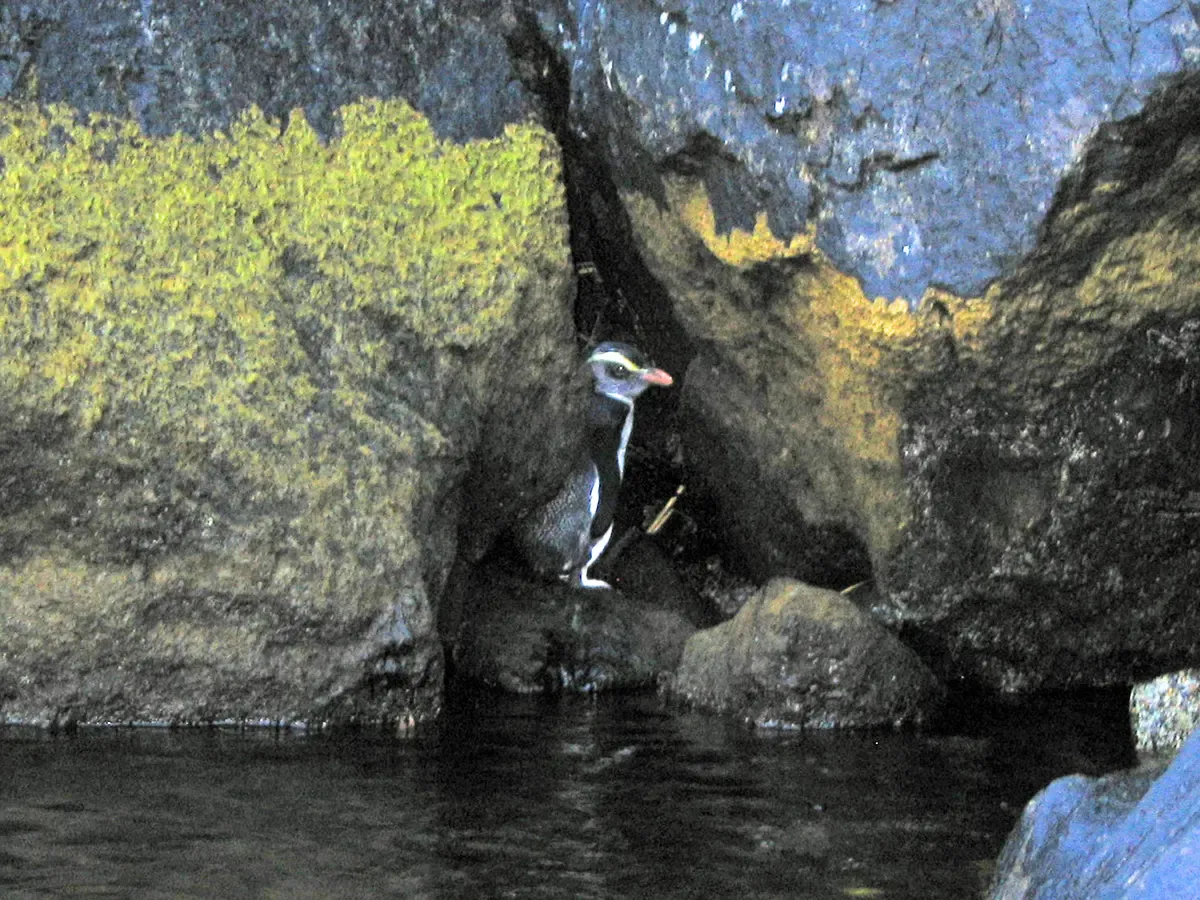
Fiordland penguin at Milford Sound, Fiordland National Park. Photo: Greg Schechter, CC BY 2.0, via Wikimedia Commons
Penguins
The penguin tier is where Milford Sound wildlife expectations most need correcting. Tawaki are real, they are here in numbers worth caring about, and they are absent for a large part of the year, which is the part most visitors do not plan for.
Fiordland Crested Penguin (tawaki)
A 55 cm, 3.5 kg penguin. DOC puts the breeding season at July to November, Wikipedia extends it to December, and moulting birds can appear mid-January to early March. Outside those windows they spend long stretches at sea, though RealNZ calls April one of the first reliable months.
The total population is only 2,500 to 3,000 breeding pairs, and they nest in small scattered groups on steep rainforest slopes. They are very timid and highly susceptible to disturbance while nesting, so keep any shore distance generous and never bring a dog near a colony. A sighting is possible in the breeding season but never guaranteed, and small boat versus large boat Milford Sound compares the vessels.
Lucky-Day Sightings
This tier is why you keep your eyes working after the waterfalls. None of these are things a cruise promises, all of them are things people genuinely see, and each lives at a specific spot rather than throughout the fiord.
Black Coral and the Underwater Wall
The name black coral refers to its black skeleton. The dark tannin freshwater layer on the fiord lets black coral grow at depths as shallow as 10 m here, and Piopiotahi is the only marine reserve where you can see black and red coral. Colonies grow slowly, with a 1.8 m colony typically 30-40 years old.
The catch is that you cannot see any of this from a cruise deck. It takes a dive along the northern rock wall, and the water is very cold and dark.
Kea
A large parrot about 48 cm long and 750-1,000 g. They gather at the Homer Tunnel area and Monkey Creek on the Milford Road, not in the fiord itself. DOC estimates 1,000 to 5,000 birds and lists the species as Nationally Endangered.
The memorable fact is their problem-solving, they open taps and move road cones. Feeding them is harmful, so do not do it. Day tours that stop at Monkey Creek, such as the Glass-Roof Coach and Cruise at $161 per person for 12.5 hours, lists Monkey Creek and the Homer Tunnel among its stops.
Whio (blue Duck)
A river duck 50-55 cm long, Endangered, found on clean fast water. Monkey Creek is a pull-over area with a good chance of spotting whio and kea, which makes it a good road stop for Milford Sound wildlife that is not marine. Only 2,500 to 3,000 birds were counted in a 2010 census.
They feed almost entirely on aquatic insect larvae in rapids, and the male's whistled call gives the species its Maori name.
Whales
Humpback and southern right whales are listed among the marine mammals seen at Milford Sound, and BirdLife International designates the area an Important Bird Area. There is no season figure sourced for either species here, so treat a whale sighting as a bonus, not something to plan around.
Where Each One Lives: Spots and Sites
The tiers above were species-first. This flips the axis to place-first, because Milford Sound wildlife is site-specific and your choice of trip decides which sites you actually reach. Every site named here is real and reachable on a listed activity.
Seal Rock and the Fiord Entrance
A rock named on the route of the Mitre Peak Small Boat Cruise at $100 per person for 2 hours, where fur seals can be looked for, with pups appearing on rocky outcrops from September. Whether you see animals there depends on the day.
Harrison Cove and the Northern Rock Wall
The cove sits against the northern wall of the Piopiotahi Marine Reserve, 690 hectares protected since 1993. This is where the underwater species live, black coral, red coral, sea pens, sponges, snakestars and anemones on the wall. Fishing and taking marine life are banned in the reserve.
Monkey Creek and the Homer Tunnel
Two road stops in the upper Milford Road, both real Milford Sound wildlife sites in their own right. Monkey Creek is the whio and kea pull-over. Kea are present at the Homer Tunnel area.
Both are reachable by anyone driving the Milford Road. Itineraries vary, and the Glass-Roof Coach and Cruise at $161 per person for 12.5 hours is the listing here that names both stops.
Sandfly Point and the Foreshore
The landings at the head of the fiord, where the sandflies live up to their name. This is boat or track territory, not a drive-up shore. RealNZ says an overnight cruise gives a dawn stillness that daytime cruises cannot, and the Overnight Cruise at $391 per person for 17 hours offers optional kayaking for guests aged 10 and over.
Sources: DOC Piopiotahi Marine Reserve
When to See Them
Most Milford Sound wildlife is year-round, so this section flags only the swings sharp enough to change your plans rather than rebuilding a month grid.
The Two Windows That Matter
Tawaki are present July to November for breeding, sometimes mid-January to early March while moulting, and at sea for long stretches outside those windows. Seal pups begin appearing on the rocks from September. Dolphins are a resident population, and Glenorchy Air notes frequent dolphin and fur seal sightings from December to February.
Weather decides more than season does, and the Milford Sound weather guide explains how rain and wind change a trip.
What You Won't (Usually) See
Two common mix-ups are worth correcting before you book.
Penguins Are Not a Year-round Certainty
Tawaki are not on the fiord's rocks every month. Their breeding season is July to November, and they can sometimes be seen moulting from mid-January to early March. Book inside July to November for the best chance.
RealNZ also calls April one of the first reliable months for penguin sightings.
The Wildlife Is Not a Zoo
The other mix-up is expecting each species at a fixed spot on a schedule, as if dolphins were stationed at Harrison Cove at 1pm. A resident population means the animals live here, not that any one trip meets them. RealNZ prints 'sightings are not guaranteed' on its own cruise pages, and that is the correct expectation for every operator in the fiord.
Responsible Wildlife Viewing
All seals, sea lions, dolphins and whales in New Zealand waters are protected under the Marine Mammals Protection Act 1978, and harassing or disturbing them is an offence. The Department of Conservation sets the numbers that matter.
The Rules That Apply to You
On the water, vessels travel at idle or no-wake speed within 300 m of any marine mammal, and no more than three vessels may be within that 300 m. Keep at least 50 m from whales and 200 m from a whale mother and calf, and never circle, obstruct or cut through a group. On shore, stay at least 20 m from seals, never touch them, and keep dogs away.
Never feed kea, it teaches them to approach people and leads to harm from vehicles and poisoned building materials. Tawaki are so vulnerable to disturbance that DOC warns a single dog can wipe out a colony. Report illegal activity on 0800 DOC HOT (0800 362 468).
Hazards to Know
The practical hazards around Milford Sound wildlife encounters are small, cold and human-shaped.
Sandflies, Cold Water and the Road
Sandflies bite at landings and the foreshore, so bug spray is recommended. The water is very cold and dark, and DOC advises against snorkelling in the reserve without proper exposure protection. On the Milford Road, avalanche control closes the road at times between June and October.
None of this should change your plans, all of it is worth ten seconds of thought before you step out of the car at Monkey Creek with a sandwich in your hand.
How to Maximize What You See
Everything above is the odds. This is what you control, written as the habits that consistently separate a good sighting morning from a ferry ride.
Field Habits That Work
These are the habits that consistently find more Milford Sound wildlife than the average deck passenger manages.
- Take a morning departure. RealNZ says morning cruises are generally quieter with calmer water before the afternoon winds, and calm water makes surface sightings far easier to read.
- Spend time at the rail rather than in the cabin, because the wildlife is outside.
- Look where the water is broken, not where it is smooth. A bow wave, a wake line or a splash means an animal.
- Ask the skipper where animals were seen earlier, on boats with live commentary.
- For children, a rock of fur seals is big and easy to point at, though sightings are never guaranteed.
- If a sighting matters more to you than anything else, the Mitre Peak Small Boat Cruise is a small vessel that Mitre Peak Cruises says is purpose-built to navigate near the shoreline, though no cruise can promise an animal.
Which Trip for Which Sighting
If You want the widest coverage of dolphin and seal water in one sailing
Take a full-length cruise to the Tasman Sea such as the Glass-Roof Catamaran Cruise, or compare all Milford Sound cruises by length and deck.
If You want to be close to the rocks at Seal Rock and tawaki shoreline
A small boat is the tool. The Mitre Peak Small Boat Cruise is purpose-built to navigate near the shoreline.
If You want kea and whio as well as the fiord
Book a road-and-cruise day that stops at Monkey Creek and the Homer Tunnel, such as the Glass-Roof Coach and Cruise.
If You want the underwater world, black coral included
A standard cruise cannot show it, so it needs a dive. The Milford Sound kayaking guide covers time on the water instead.
Milford Sound Wildlife FAQ
What is the most common thing you'll see in Milford Sound?
New Zealand fur seals are the most common seals in the country and haul out on rocks around the fiord, but no sailing is guaranteed to see them. The Mitre Peak Small Boat Cruise names Seal Rock on its route.
Will I definitely see dolphins?
No. A resident population of bottlenose dolphins lives in the fiord year-round, but no operator can promise a sighting. Trips that run the full length of the fiord, like the Glass-Roof Catamaran Cruise, cover more dolphin water.
Can I touch the seals or penguins?
No. DOC says stay at least 20 m from seals on shore and never touch them, they can be aggressive and carry disease, and all marine mammals are protected under the Marine Mammals Protection Act 1978. The responsible viewing rules above list the distances that apply.
When can I see penguins in Milford Sound?
Tawaki breed from July to November, and moulting birds appear from mid-January to early March, so they spend long stretches at sea the rest of the year. RealNZ calls April one of the first reliable months, and seasonal detail sits in the when to see them section.
What is the rarest thing you might see?
A humpback or southern right whale in the outer fiord is among the rarer sightings listed for Milford Sound, with no published season. Black coral needs a dive, and the Milford Sound kayaking guide covers time on the water.
Are there dangerous animals in Milford Sound?
The practical hazards are biting sandflies on the foreshore, very cold water and seals on shore, which can be aggressive. The full list sits in the hazards section above.