 Milford Sound Boat Tour
Fiordland National Park: the Park Around Milford Sound
Fiordland National Park is the Milford Sound national park, the largest in New Zealand and the reason a boat trip here feels the way it does. This guide covers the park itself: its 12,607 square kilometres, its 15 fiords, its World Heritage status, its Great Walks and its wildlife. It also explains how to see it in a day or two, from the cruises on the fiord listed in the comparison of Milford Sound boat tours to the roads and flights that reach it. Details of the Milford Road and of how Milford compares with Doubtful Sound live on their own pages, which are linked where relevant.
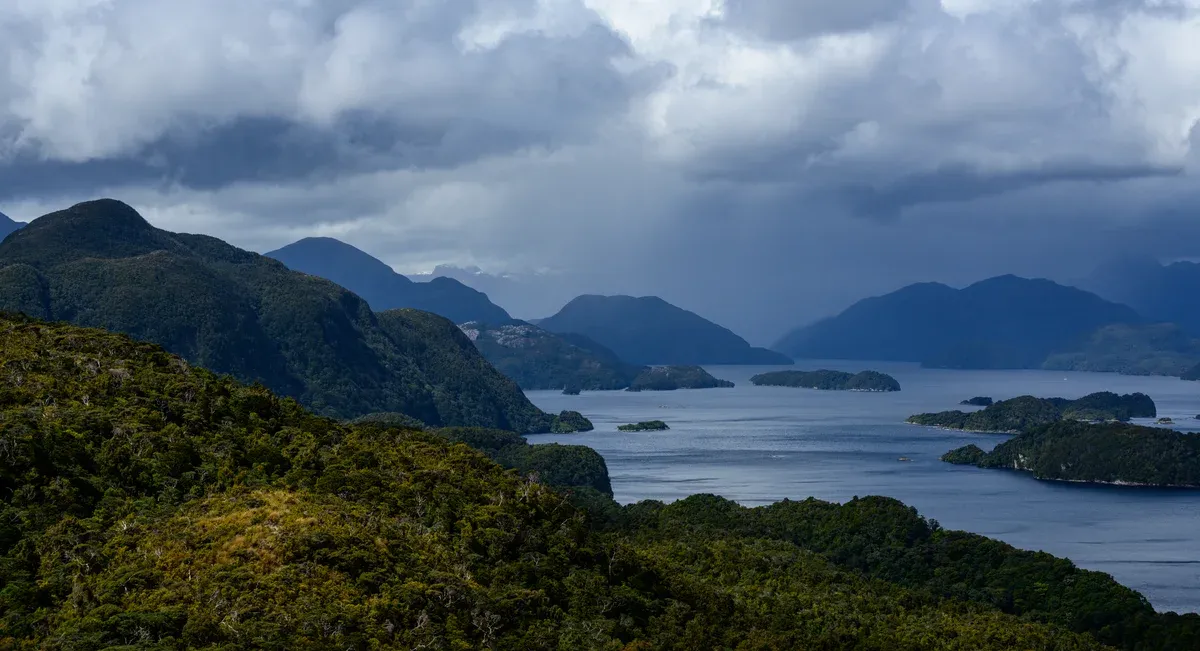
Dusky Sound / Tamatea in Fiordland, New Zealand. Photo: Jake Osborne, CC BY-SA 2.0, via Wikimedia Commons
Quick answer Fiordland National Park at a glance
Fiordland National Park is the Milford Sound national park: it covers 12,607 square kilometres, was established in 1952 and is the largest of New Zealand's 13 national parks. Milford Sound, its most famous fiord, sits 15 kilometres inland from the Tasman Sea.
Key takeaways
- The park holds 15 fiords, including Milford, Doubtful and Dusky Sounds, and sits inside the Te Wāhipounamu World Heritage area inscribed in 1990. Compare the two big fiords in the Milford Sound vs Doubtful Sound guide.
- The easiest way onto the water is a cruise, such as the Mitre Peak Small Boat Cruise at $100 per person or the Glass-Roof Catamaran Cruise at $93 per person.
- Four Great Walks start or finish in the park, led by the 53.5 km Milford Track, walked in the season from 1 November to 30 April.
- Rainfall exceeds seven metres a year in many parts of the park, so pack a raincoat. See what the weather means for your trip in the guide to Milford Sound weather.
The Park in Figures
Fiordland is a park best understood through its scale.
Key Numbers
The figures below set Fiordland against its peers and against itself. It is the largest of New Zealand's 13 national parks, and its rainfall figures dwarf those of the towns on its edge. The World Heritage listing covers Fiordland along with three other parks.
These figures come from public references including Wikipedia and the Department of Conservation, and each one is traceable.
| What | Figure |
|---|---|
| Area | 12,607 km2, the largest of New Zealand's 13 national parks |
| Established | 1952 |
| World Heritage | Part of Te Wāhipounamu, inscribed in 1990, covering 2,600,000 hectares |
| Fiords | 15, including Milford, Doubtful and Dusky Sounds |
| Rainfall | Exceeds 7 metres a year in many parts of the park |
| Great Walks | Milford Track (53.5 km), Kepler Track (60 km), Routeburn Track (32 km, shared) and Hump Ridge Track (60-62 km) |
The Fiords
Fiordland's 15 fiords are the park's defining feature, and Milford is only the most visited of them.
Milford Sound / Piopiotahi
Milford Sound is the fiord almost everyone comes to see. Its official name is Milford Sound / Piopiotahi, and it is a fiord in the true geological sense, carved by glaciers, not a river valley flooded by the sea. It runs 15 kilometres inland from the Tasman Sea, is up to 1.94 kilometres wide and covers about 25 square kilometres. The rock walls on either side rise 1,200 metres or more, and Mitre Peak is the peak that dominates the fiord.
Māori visited the fiord over 1,000 years ago, and Captain John Grono made the first recorded European sighting around 1812, naming it after Milford Haven in Wales. Rudyard Kipling later called it the eighth Wonder of the World. Today the easiest way to experience it is on the water, and the comparison of Milford Sound boat tours runs from a $80 Classic cruise to the $391 overnight cruise.
Doubtful Sound / Patea
Doubtful Sound is the second largest fiord and, by several measures, the bigger spectacle: RealNZ puts it at three times the length of Milford and five times deeper, about 40 kilometres long and up to 421 metres deep by Wikipedia's measure. It has no direct road access. Every visit starts with a boat across Lake Manapouri, then a coach over the 671 metre Wilmot Pass to Deep Cove, where the cruise begins.
That journey gives Doubtful a different feel, with more widespread and less vertical cliffs than Milford. Rainfall there runs 3,000 to 6,000 millimetres a year against Milford's higher totals. For a full side-by-side of the two fiords, read the Milford Sound vs Doubtful Sound page. The Doubtful Sound Day Cruise from Manapouri is a 7-hour day at $179 per person with up to 3 hours on the sound.
Dusky Sound and the Rest
The park's 15 fiords also include Dusky Sound, one of the most remote, along with the three arms of Doubtful itself: First Arm at 6 kilometres, Hall Arm at 8 kilometres and Crooked Arm at 14 kilometres.
The park also holds an inland curiosity. Lake Te Anau, the largest lake in the South Island at 344 square kilometres and 65 kilometres long, has three fiords of its own on the western shore: North, Middle and South Fiords. These are the only inland fiords in New Zealand, set against the 14 coastal ones, and the lake's surface sits 210 metres above sea level with a maximum depth of 425 metres.
The Great Walks
Fiordland holds four of New Zealand's Great Walks, the country's premier multi-day tracks.
Milford Track
The Milford Track is the famous one: 53.5 kilometres over 4 days and 3 nights, walked in one direction only, from Glade Wharf on Lake Te Anau to Sandfly Point near the fiord. DOC splits it into daily stages of 5, 17.5, 13 and 18 kilometres, with huts at Clinton, Mintaro and Dumpling, and the track crosses Mackinnon Pass at around 1,140 metres. Sutherland Falls, at 580 metres, is one of its landmarks.
The Great Walks season runs from 1 November to 30 April with compulsory online booking, and hut fees are NZ$106 per night for New Zealand adults and NZ$152 for international adults in season. Starts are capped at 90 walkers a day, 40 independent and 50 guided. A boat from Te Anau Downs takes 1 hour 15 minutes to the start, and a short boat ride from Sandfly Point ends the walk. Quintin McKinnon found the pass in 1888 and became the track's first guide.
Kepler Track
The Kepler Track is a 60 kilometre loop starting near Te Anau and taking 3 to 4 days. It opened in February 1988 as part of the national park's centennial celebrations. Its huts are Luxmore (54 beds), Iris Burn (50) and Moturau (40), plus a campsite at Brod Bay, and its highest point is Luxmore Saddle at 1,400 metres.
It is a loop, so it starts and finishes at the same trailhead.
Routeburn Track and Hump Ridge
The Routeburn Track is 32 kilometres and takes about 3 days, shared between Fiordland and Mount Aspiring National Parks with the border at Harris Saddle at 1,255 metres. Its Fiordland trailhead is The Divide on SH94 at 532 metres, and the Key Summit side trip reaches 918 metres. A half day walk option runs between The Divide and Key Summit if you are driving the road to Milford. The Fiordland end of the track gets much less rain than Milford Sound itself.
The park's fourth Great Walk is the Hump Ridge Track at 60 to 62 kilometres over three days, which opened as New Zealand's eleventh Great Walk in 2024. Its Percy Burn Viaduct, built in 1916, is a Category One Historic Place. Nationally, Great Walks range from the Routeburn's 32 kilometres to the Heaphy's 82.
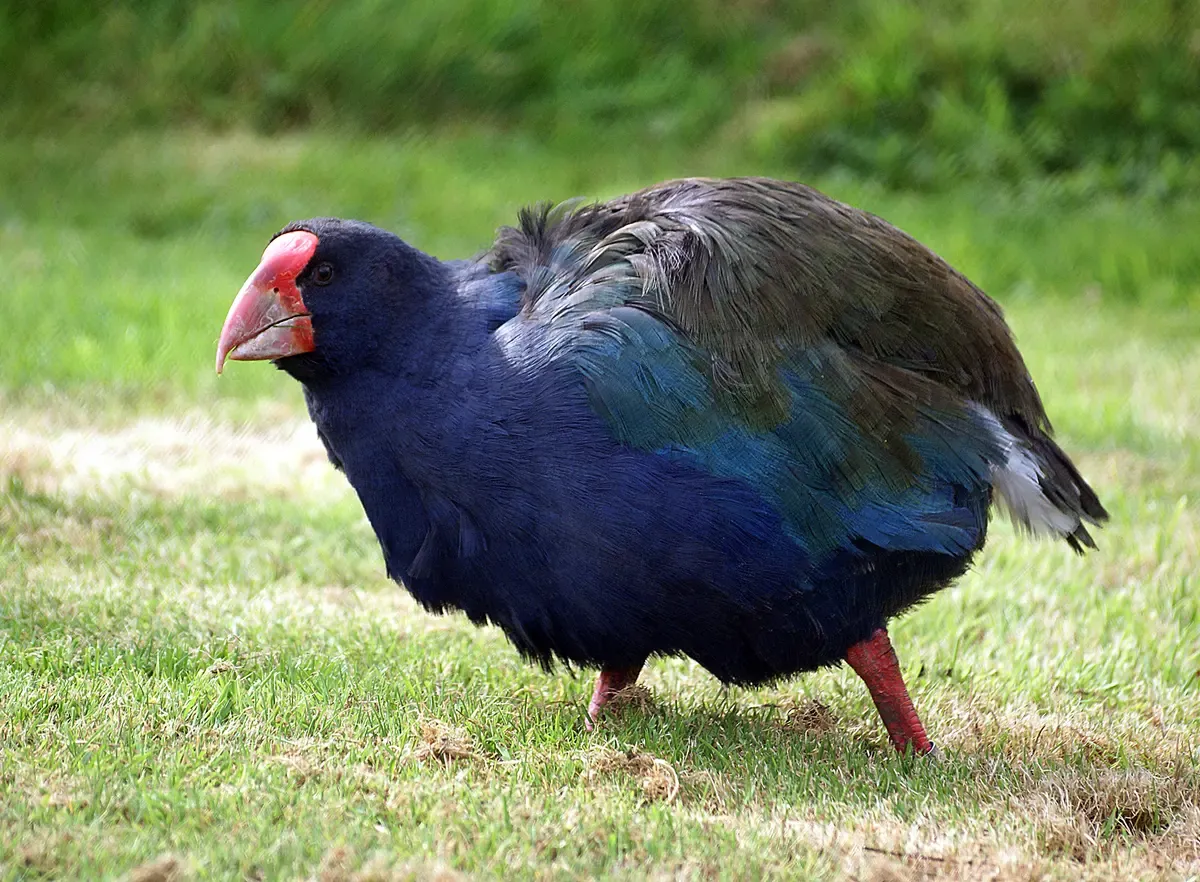
A South Island takahe. Photo: Bernard Spragg. NZ from Christchurch, New Zealand, CC0, via Wikimedia Commons
Birds and Marine Life
The park's animals are a large part of why it earned World Heritage status.
Takahē, Kea and Whio
The South Island takahē was rediscovered on 20 November 1948 in the Murchison Mountains near Lake Te Anau, about fifty years after it was presumed extinct. It is the largest living member of the rail family, about 63 centimetres long with blue-purple plumage and a scarlet frontal shield, and numbers have grown to around 500 birds, rising about 8 percent a year. It was downgraded from Endangered to Nationally Vulnerable in 2016.
Kea, the alpine parrot, gather at the Homer Tunnel area and at Monkey Creek on the Milford Road. DOC estimates 1,000 to 5,000 birds and lists the species as Nationally Endangered. Feeding them is harmful, because it teaches them to approach people and vehicles. Whio, the blue duck, need clean fast rivers and are best looked for at Monkey Creek, a pull-over spot with a good chance of seeing them alongside kea. The park was also a 20th century refuge for kākāpō, the world's heaviest parrot, though sightings were scarce by the 1940s and birds were later moved to Codfish Island (Whenua Hou).
Penguins, Seals and Dolphins
Fiordland crested penguins, tawaki, breed from July to December and are best seen in the July to November window, with Milford Sound one of the places to spot them. The population is between 2,500 and 3,000 breeding pairs, and DOC lists the species as Endangered. They nest in small scattered groups on steep rainforest slopes and are very timid.
New Zealand fur seals, kekeno, haul out on rocky outcrops, with pups appearing from September according to RealNZ. The fiord also holds a resident population of bottlenose dolphins, among the southernmost wild populations in the world, and Wikipedia lists humpback and southern right whales among the marine mammals seen at Milford Sound. On shore, stay at least 20 metres from seals, and never touch one. The Milford Sound wildlife guide covers the animals in more detail.
Life Under the Freshwater Layer
Rain-washed tannins from the forest form a dark freshwater layer over the sea water, and that layer cuts the light so completely that deepwater species survive at easy viewing depths. Black coral grows as shallow as 10 metres in Milford Sound, along with red coral, sea pens, sponges, tubeworms, sea squirts and anemones on the northern rock wall.
The same tannin layer is what allows black coral, a genus where nearly 75 percent of species live below 50 metres, to thrive in the shallows here. DOC lists rock cod, butterfly perch, kina, snakestars and dogfish among the reserve's other species, and the waters are protected as the Piopiotahi marine reserve.
How to See the Park in a Day or Two
Most visitors base themselves in Te Anau and see the park from the water, the road and the air.
Te Anau, the Gateway
Te Anau sits on the edge of the park, 171 kilometres southwest of Queenstown and 117 kilometres south of Milford Sound, and functions as the base for nearly everyone visiting Fiordland. The town of about 2,920 people sits beside Lake Te Anau, the largest lake in the South Island, with summer daily maximums around 20.0°C and annual rainfall of 1,202.5 millimetres, a fraction of what falls inside the park.
The DOC-run Fiordland National Park Visitor Centre (Te Rua-o-te-moko) is at 1 Lakefront Drive, with a temporary base at 26 Town Centre during refurbishment. It sells Great Walk tickets and maps and provides track and weather information. Summer hours are 8:30am to 4:30pm (9am to 4:30pm on Wednesdays) and winter hours are 9am to 12pm and 1pm to 4pm, closed Sundays. The RealNZ Te Anau Glowworm Caves tour on the lake's western shore starts from NZD $154 with up to 12 guests per guide, though cameras are not permitted in the caves.
Cruises and Day Tours
A cruise is how most people meet the park's fiords, and Milford runs them 365 days a year. On the fiord itself, the Classic and Signature Cruises start at $80 per person, while the Overnight Cruise at $391 per person is a 17-hour stay aboard with dinner and breakfast. From Te Anau, the pick for a full day is the Full-Day Tour from Te Anau at $180.30 per person, a 9.5-hour small group trip with a 1 hour 45 minute cruise, or the Cruise and Walks from Te Anau at $187.33 per person with guided walks included.
Doubtful Sound needs the longer logistics of a lake crossing and the Wilmot Pass coach, described on its own page. In town, remember that cruises do not include lunch unless stated, so check each listing before you book.
The Road and the Flights
The Milford Road, SH94, links Te Anau to the fiord and is one of the great drives of the country, passing Mirror Lakes, Lake Gunn and Monkey Creek before climbing to the Homer Tunnel. Driving and the road's stops are covered fully in the Milford Road guide, so they are not repeated here.
The other option is the air. Fly-cruise trips from Queenstown cut the journey to a few hours, such as the Flight and Cruise from Queenstown at $512.29 per person over 4.5 hours or the Fly-Cruise-Fly from Queenstown at $467 per person over 5 hours, and both include a cruise on the fiord, with the first listing a guaranteed window seat.
Tips for Visiting the Park
Do
- Do pack a good raincoat, because Fiordland's rainfall exceeds seven metres a year in many parts and DOC says every visitor should carry one.
- Do allow extra days in Te Anau, because the drive from Queenstown is long and Milford Sound rains on roughly 180 to 200 days a year.
- Do stop at Monkey Creek on the Milford Road, because it gives you a good chance of spotting whio and kea from the roadside.
- Do book Great Walk huts online in advance for the 1 November to 30 April season, because booking is compulsory and Milford Track starts are capped at 90 walkers a day.
- Do visit in the rain if you can, because heavy rain feeds dozens of temporary waterfalls, some falling a thousand metres, and RealNZ says many say you have not seen Fiordland unless you have seen it in the rain.
Don't
- Don't feed kea at the Homer Tunnel or anywhere else, because feeding teaches them to approach people and leads to harm from vehicles, building materials and rubbish.
- Don't get closer than 20 metres to seals on shore, because DOC says fur seals can be aggressive and carry disease, and you should never come between a seal and the sea.
- Don't walk the Milford Track as a day walk, because DOC states it cannot be walked in a single day and runs it as a 4-day one-directional route.
- Don't plan a Doubtful Sound trip expecting to drive to the fiord, because no private vehicle can use the Wilmot Pass Road and there is no direct road into the sound.
Fiordland National Park FAQ
Is Milford Sound inside a national park?
Yes, Milford Sound sits inside Fiordland National Park, which covers 12,607 square kilometres and was established in 1952. The fiord itself runs 15 kilometres inland from the Tasman Sea. See how to get onto the water in the Milford Sound boat tour comparison.
What is so special about Fiordland National Park?
It holds 15 fiords, rainfall above seven metres a year in places, wildlife such as kea, fur seals and Fiordland crested penguins, and four Great Walks, and it forms part of the Te Wāhipounamu World Heritage area inscribed in 1990. Its most famous sight is the fiord described in the Mitre Peak guide.
Is Milford Sound one of the 7 Wonders of the World?
No, but Rudyard Kipling called it the eighth Wonder of the World, a phrase still quoted today. It holds no official list position. You can judge it yourself from the water with Milford Sound boat tours.
How many fiords are in Fiordland National Park?
The park contains 15 fiords, including Milford, Doubtful and Dusky Sounds. Lake Te Anau adds three inland fiords of its own, the only ones in New Zealand. The differences between the two you can visit are set out in the Milford Sound vs Doubtful Sound guide.
What is the best time to visit the Milford Sound national park?
The Great Walks season runs from 1 November to 30 April, and summer at the fiord brings mean daily maximums of about 19.5°C in January, but the park is open year round and rain falls in every month. The guide to Milford Sound weather compares the seasons in detail.
Where is the Fiordland National Park visitor centre?
The Fiordland National Park Visitor Centre (Te Rua-o-te-moko) is in Te Anau at 1 Lakefront Drive, with a temporary base at 26 Town Centre during refurbishment. It sells Great Walk tickets and maps and is open daily in summer. From town you can also join the Full-Day Tour from Te Anau to reach the fiord.