 Milford Sound Boat Tour
Milford Sound Weather: Climate, Rain and the Best Time to Visit
Milford Sound weather is the reason the fiord looks the way it does. Rain falls here on more than 180 days a year, several metres of it annually, and when it rains hundreds of temporary waterfalls form down the cliffs. This guide gives the monthly climate table, the season-by-season picture, what rain means for a cruise, how the Milford Road and the scenic flights cope with winter, and what to pack. Weather should shape your plan, not cancel it. The bookable tours are compared on Milford Sound boat tours.
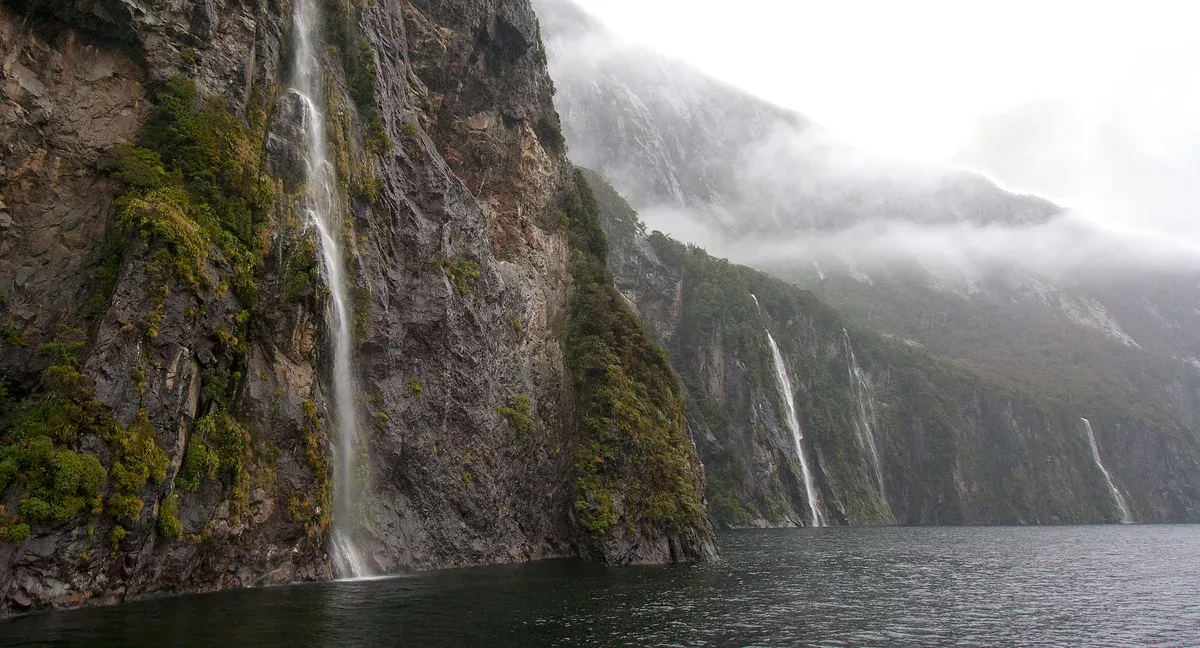
A moody day on Milford Sound after recent rain, with clouds above a row of waterfalls on the cliff faces. Photo: Lawrence Murray from Oxford, United Kingdom, CC BY 2.0, via Wikimedia Commons
Quick answer Milford Sound weather at a glance
Milford Sound weather gets several metres of rain a year (Wikipedia gives 6,412 mm) over more than 180 rainy days, with mean monthly highs from 9.2 C in July to 20.0 C in February. The fiord is not a fair-weather destination. Cruises run 365 days a year, and the rain is part of the attraction because it creates hundreds of temporary waterfalls along the cliffs.
Key takeaways
- The wettest month is January at 667.2 mm and the driest is June at 440.4 mm, so there is no dry season. See the full Milford Sound weather by month table below.
- Rain makes the show bigger, not smaller. On wet days the sound gains dozens of extra cascades on top of the two permanent falls, which is exactly what a small boat cruise goes out to find.
- Winter is the quietest season but the Milford Road carries snow chain rules and avalanche closures. The road itself is covered in detail on the Milford Road page.
- If low cloud closes the airport, RealNZ and Glenorchy Air return you by coach, and RealNZ refunds the flight leg. Alternatives are compared in the fly-cruise section of the homepage.
Milford Sound Weather by Month
Milford Sound has no dry month. The figures below are the 1991-2020 climate normals recorded at Milford Sound Airport at the head of the fiord.
Monthly Climate Table
The table lists the mean daily maximum, the mean daily minimum, the mean monthly rainfall and the mean number of rain days for every month, taken from the 1991-2020 climate normals recorded at Milford Sound Airport. For context, the annual mean daily maximum is 14.9 C, the annual mean daily minimum is 6.4 C and the mean temperature is 10.6 C. The records since 1934 stand at 29.4 C in February and -6.1 C in July. Mean relative humidity runs from 88.9% in December to 95.2% in June, and the average relative humidity for the year is 92.8%.
| Month | High | Low | Rain | Rain days |
|---|---|---|---|---|
| January | 19.5 C | 10.7 C | 667.2 mm | 16.3 |
| February | 20.0 C | 10.7 C | 466.6 mm | 12.8 |
| March | 18.5 C | 9.2 C | 571.3 mm | 14.4 |
| April | 15.9 C | 7.0 C | 528.2 mm | 13.3 |
| May | 12.5 C | 4.9 C | 645.1 mm | 15.6 |
| June | 9.3 C | 2.3 C | 440.4 mm | 14.6 |
| July | 9.2 C | 1.6 C | 468.0 mm | 14.4 |
| August | 11.2 C | 2.7 C | 457.0 mm | 16.0 |
| September | 13.2 C | 4.1 C | 541.3 mm | 17.6 |
| October | 15.0 C | 5.8 C | 617.2 mm | 17.6 |
| November | 16.4 C | 7.6 C | 557.7 mm | 15.3 |
| December | 18.5 C | 9.7 C | 585.1 mm | 16.9 |
What the Table Means for a Cruise
Read the table one way and the answer is always the same. Every month brings at least 440 mm of rain and at least 12.8 rain days, so any cruise day carries a decent chance of shower. February is the statistical best bet, with the warmest high at 20.0 C and the fewest rain days at 12.8. September and October are the wettest by count of rain days at 17.6 each, even though their rain totals sit near the middle of the range.
Read it a second way and the numbers stop mattering much. Rainfall at the fiord can reach 250 mm in 24 hours, and that kind of downpour makes dozens of temporary waterfalls, some falling a thousand metres down rock. The same rain can send whole sections of rainforest sliding off the sheer cliffs as tree avalanches. The weather you get on the day matters more than the month you booked, which is why checking the forecast the evening before is worth more than picking a statistically dry month.
One more useful contrast. Te Anau, the usual overnight base, gets 1,202.5 mm of rain a year against more than 6,000 mm at Milford Sound. A blue morning in Te Anau tells you almost nothing about conditions at the coast, 120 km away through the mountains.
Rain Is the Show
Milford Sound is a very wet place, and operators treat the rain as a selling point rather than a warning.
How Much Rain Actually Falls
The sources disagree on the exact figure, which is itself useful to know. DOC says Milford Sound gets up to 7 m of rain per year. Wikipedia gives 6,412 mm annually, while the twelve monthly normals on the same table add up to 6,545.1 mm. Southern Discoveries puts it at around 7.5 m a year. Whatever number you take, the scale is the same: several metres of water arrive over the fiord every year, several times what falls on Te Anau (1,202.5 mm a year).
Rain days tell the same story. Wikipedia counts 184.8 rainy days a year, Southern Discoveries says 182 on one page and about 200 on another. On roughly half the days of the year, some rain falls.
Why Rainy Days Make Better Waterfalls
Milford Sound has only two permanent waterfalls, Stirling Falls and Bowen Falls. Bowen Falls, named Hineteawa in Maori, drop about 160 metres and are fed by the 9 km Bowen River. Stirling Falls sits at 151 metres by Wikipedia's measure, though Southern Discoveries lists it as 155 metre high, and has existed for 15,000 years. Everything else on the cliff faces is rain-fed.
When it rains, hundreds of temporary cascades form along the mountainsides. They are fed by rain-soaked moss and last a few days after the rain stops, so a cruise a day after a storm still finds them running. Semi-permanent falls such as Fairy Falls and Palisade Falls can last up to two weeks without rain, and Fairy Falls rarely dries up completely even in summer. RealNZ puts it plainly: many say you have not seen Fiordland unless you have seen it in the rain.
The practical consequence is that you can cruise Milford Sound 365 days a year. Rain does not close the fiord, and a glass-roof catamaran cruise with indoor seating and outdoor decks works in both states of the sky. DOC's advice for the fiord is simply that every visitor should have a good raincoat.
The Best Time to Visit
There is no off season at Milford Sound. Every month offers a different experience, and the right choice depends on crowds, wildlife and road conditions rather than temperature.
Summer, December to February
RealNZ puts summer at 18-25 C and Glenorchy Air calls December to February the busiest months, with long daylight, warmer temperatures and frequent dolphin and fur seal sightings. In summer it does not get dark until after 9:00pm, which stretches what you can fit into a day. January is the busiest month at the fiord, and RealNZ says summer needs booking well ahead. Wikipedia notes that roads and facilities are congested in the main season because tour operators from Queenstown leave very early, so most visitors reach Milford Sound within a few hours of midday.
RealNZ also says morning departures are generally quieter with calmer water before the afternoon winds, advice that matters most in summer when every departure fills.
Autumn, March to May
RealNZ puts autumn at 12-20 C. Glenorchy Air says autumn brings dramatic waterfalls, softer light and noticeably smaller crowds than summer. The monthly table shows the temperature drop: March still averages an 18.5 C high, while May drops to 12.5 C with 645.1 mm of rain.
Winter, June to August
Winter runs June to August at 5-10 C by RealNZ's reckoning, and Glenorchy Air calls it the quietest season, with snow-capped peaks and crisp skies. Snow settles on Mitre Peak from June onward. Intrepid says winter brings maximum solitude and spectacular waterfalls from torrential downpours but needs thermal clothing. July is the coldest month in the table, a 9.2 C high and a 1.6 C low, and the record low of -6.1 C was set in July.
The catch sits on the road. Wikipedia says the Milford winter road is very prone to avalanches and closures during the winter half of the year. Between May and November, when required, all vehicles on the Milford Road must carry or fit snow chains, and Milford Lodge phrases the rule as June through November, conditional on road status. Chains can be hired at any Te Anau petrol station. Marian Corner avalanche gates close whenever there is avalanche danger, and the road stays shut until explosives clear the snow.
Against that, July to November is the best window for penguins. See the next block, or the rain and wildlife section of the homepage for the wider animal picture.
Spring, September to November, and Penguin Season
RealNZ puts spring at 10-18 C and picks November as a strong month, with reliable weather, fewer visitors than peak summer and active wildlife. Glenorchy Air says spring has waterfalls at their fullest, seal pups on the coast and vivid green rainforest. Daylight saving begins in late September, which adds evening light.
The wildlife headline is penguins. The best time to see Fiordland crested penguins, tawaki, is the July to November breeding season, and Milford Sound is one of the places to spot them, so winter and early spring are the prime viewing months. The tawaki population is between 2,500 and 3,000 breeding pairs, each bird about 55 cm long and averaging 3.5 kg. They can sometimes also be seen during moulting from mid-January to early March. RealNZ adds that seal pups and penguin chicks appear in spring and lupins bloom along the Milford Road.
If none of these suits, remember that Fiordland weather does not follow the calendar closely, so clear visibility is possible in any month. The pick for a single recommendation is November, but any month works with the right expectations. For seeing the fiord at its quietest, an overnight cruise lets you stay after the day buses leave, and RealNZ says it gives a dawn stillness and light quality that daytime cruises cannot.
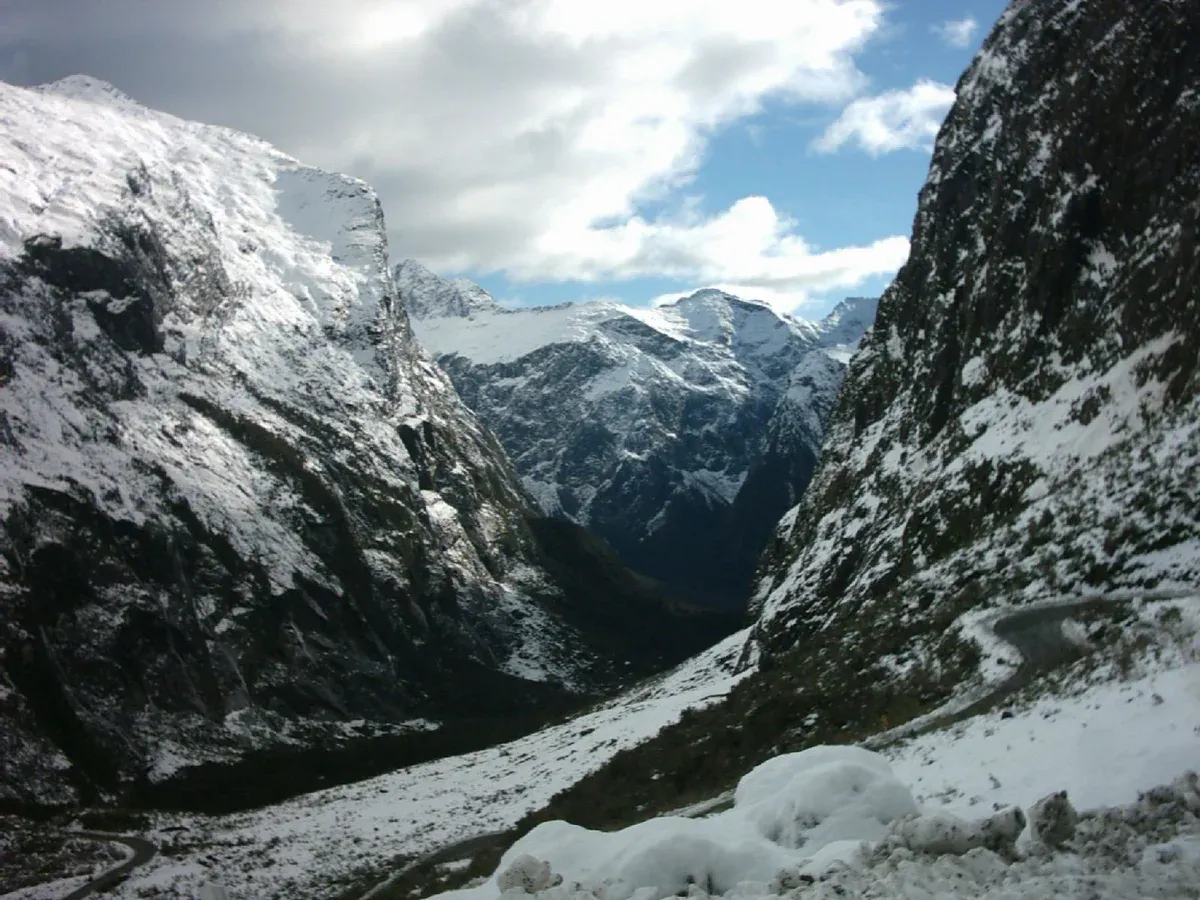
Looking west from the Homer Tunnel portal into the Cleddau Valley, with early-winter snow against rain-slick dark rock. Photo: Ingolfson at English Wikipedia, Public domain, via Wikimedia Commons
When Weather Changes the Plan
The fiord itself never closes. The two things that can change are the flight in and the road over the mountains.
Flights and Weather
Charter flights into Milford Sound Airport run daily weather permitting. The airport has a single 782 m asphalt runway at the head of the fiord, 3 m above sea level, and Queenstown Airport says the flight from Queenstown typically takes 30-40 minutes one way. Flights run weather permitting, so low cloud or strong wind can cancel them.
The operators build for this. Milford Sound Scenic Flights checks the weather 1.5 hours before departure. RealNZ says when a flight is cancelled the guest returns by coach and the flight component is refunded, and Glenorchy Air makes the same promise: if conditions are unsafe, passengers return to Queenstown by coach. So a weather cancellation costs you the flight leg, and the operator's terms decide the rest. Which fly-cruise packages include that guarantee is laid out on the Milford Sound scenic flight page, and if you want the flight leg as the point of the day, the Fly-Cruise-Fly from Queenstown runs 5 hours door to door with a 2-hour cruise.
Road Closures and Avalanches
SH94, the Milford Road, stays open year-round but carries avalanche control closures between June and October, per RealNZ. In winter the road is closed if there is avalanche danger until explosives clear the snow, and the road is closed an average of 8 days a year, mainly in winter. The Marian Corner gates and the 'Avalanche Area No Stopping' signs must be obeyed whenever they are up.
There is no mobile phone coverage along the Milford Road, so check road conditions on 0800 4 HIGHWAYS (0800 444 449) before you leave Te Anau, and again at the last point of coverage. Drivers planning the trip themselves should read the Milford Road guide for the stop-by-stop detail, or leave the car and take a coach day trip.
Weather Tips for Milford Sound
Five things to do and four to skip, all drawn from the official advice for the fiord and the road.
Do
- Do bring a good raincoat, because Fiordland's high rainfall means every visitor should have one, and rain falls on about half the days of the year.
- Do bring warm and waterproof layers for walks and the cruise, because the mean temperature is only 10.6 C and the boat moves, which makes it feel colder.
- Do bring a windproof jacket for the outdoor viewing decks, because the outdoor viewing decks are exposed to the wind.
- Do pack insect repellent, because there are sandflies both on the Milford Road and at Milford Sound itself.
- Do check road conditions on 0800 4 HIGHWAYS (0800 444 449) before driving in winter, because there is no mobile phone coverage along the Milford Road once you have left.
Don't
- Don't drive without chains between May and November when required, because all vehicles on the Milford Road must carry or fit snow chains and closures follow any avalanche danger.
- Don't skip a rainy day cruise, because on rainy days the waterfalls in the sound are bigger and more numerous than on clear days, with hundreds of temporary cascades on the cliffs.
- Don't feed the kea at the Homer Tunnel area, because feeding them is harmful to them.
- Don't assume a clear morning in Te Anau means clear weather at the fiord, because Te Anau gets 1,202.5 mm of rain a year against more than 6,000 mm at Milford Sound, and the mountain weather does not match the forecast at your base.
Milford Sound Weather FAQ
Is it worth going to Milford Sound in the rain?
Yes. RealNZ notes that many say you have not seen Fiordland unless you have seen it in the rain. When it rains, hundreds of temporary cascades form along the mountainsides, adding to the two permanent falls, and the rain-soaked moss keeps them running for a few days afterwards. Cruises run 365 days a year, so the cruises on the fiord never close for weather.
Is a Milford Sound cruise cold?
It can be. The annual mean temperature at the fiord is 10.6 C, July highs average just 9.2 C, and the average relative humidity is 92.8%, so wind chill on a moving boat is real. Official advice is to bring warm and waterproof layers plus a windproof jacket for the outdoor decks, whatever the season. The packing list above covers the full Milford Sound weather picture.
What is the best time of year to visit Milford Sound?
There is no off season. RealNZ picks November as a strong month, with reliable weather, fewer visitors than the January peak and active wildlife, while winter from June to August is the quietest season and penguin breeding season runs from July to November. The season-by-season breakdown is in the best time to visit section above.
Does it snow in Milford Sound?
Snow settles on the peaks. The record low at Milford Sound Airport is -6.1 C, set in July, and RealNZ says snow settles on Mitre Peak from June onward. What snow does affect is the Milford Road, where all vehicles must carry or fit chains when required between May and November, a rule detailed on the Milford Road page.
When can I see penguins in Milford Sound?
Fiordland crested penguins, tawaki, breed from July to November, which makes winter and early spring the prime viewing season at the fiord. They can sometimes also be seen during moulting from mid-January to early March. Sightings are not guaranteed on any cruise, as operators like RealNZ state plainly, so treat penguins as a bonus of a winter visit.
What happens to a fly-cruise trip when the weather turns?
The flight leg is the part at risk, because charter flights into Milford Sound run only weather permitting. RealNZ refunds the flight component and returns guests to Queenstown by coach, and Glenorchy Air makes the same coach-back promise if conditions are unsafe. Read your operator's terms for what happens to the rest of the day, or pick a day trip from Queenstown by road instead.